
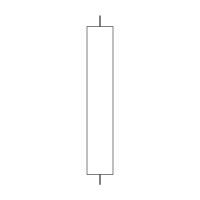
In Japanese “Marubozu” means almost bald. That is an apt name for the single candlestick pattern we are about to discuss called the “White Marubozu” or long white candlestick.
As discussed in the anatomy of a candlestick, you can see that the top part of the candlestick is the highest price of the day, the bottom of the candlestick is the lowest price of the day and the body of the candlestick shows the open and close. If it is a white candlestick, then you have the open at the bottom end of the body and the close price at the top. This shows that it was a bullish day where buyers were in control and had increased the price of the instrument.
In a Marubozu or long white candlestick, you will see that there is hardly any wick at either end of the candlestick. When a candlestick has no wicks on either end or just barely has wicks, that indicates that the open and close prices were right on or close to the high and low price of the day. This indicates a very aggressive buying situation where the buyers were buying up whatever the sellers had to offer.
The Buy Signal
When you see a long white candlestick or a Marubozu, it would indicate that the day closed with buyers in control and aggressive buying. It might also be safe to assume that this buying would continue into the next day. That is an ideal situation to buy that instrument. So, you could be seeing a buy signal when you see a perfect or near-perfect White Marubozu.
The Confirmation
When you see a long white candlestick and decide it is a buy signal, you will have to keep an eye on this instrument to make sure they buy signal is valid. If over the next few days, the price of the instrument does not drop below the low of the Marubozu you had used for the buy signal, then you can say that the buy signal is valid.

If the price of the instrument falls below the low of the Marubozu then you can say that the buy signal is no longer valid and that the support level has failed. Therefore it is always advisable to place a “stop order” just below the low of the Marubozu so that if they buy signal fails, you would exit the trade with a small loss and prevent a larger loss.

Variations of Marubozu
The white Marubozu comes in 3 variations: the white Marubozu (no wicks on either end), the closing white Marubozu (with a wick at the bottom only), and the opening white Marubozu (with a wick at the top only).


